ColorNest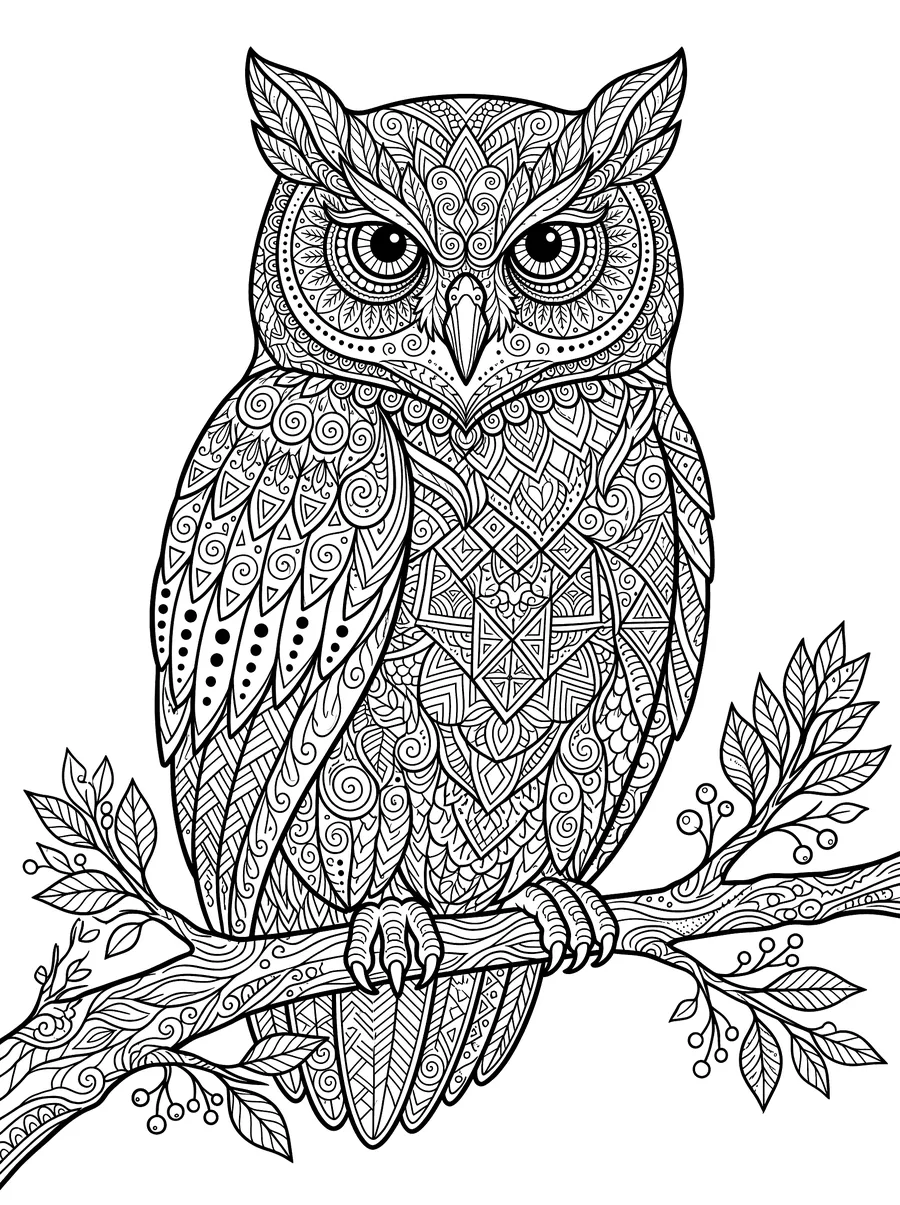
Owls have fascinated humans across cultures for thousands of years. They appear as symbols of wisdom in ancient Greek culture (associated with the goddess Athena), as omens in some Indigenous American traditions, and as guardians in Hindu mythology. Owls can rotate their heads up to 270 degrees — not 360, as is commonly believed — because they cannot move their eyes in their sockets. To compensate, owls evolved extra neck vertebrae and a special blood-pooling system that keeps their brains supplied with blood during extreme head rotation. Most owls are nocturnal hunters with asymmetrically placed ears, allowing them to triangulate sound with extraordinary precision.
Coloring ideas: the large facial discs around the eyes stand out beautifully in deep amber or burnt sienna. Give the wing feathers alternating earth tones — chocolate brown, warm tan, and rust orange — with each zentangle section colored differently to show the pattern variety. The leafy branch works well in natural greens and grey-browns.
The owl's large eyes are a natural focal point: color the irises in striking golden yellow or copper before working outward. Leave some sections in a very light color to create contrast against the darker tangle areas — not everything needs to be deeply saturated.