ColorNest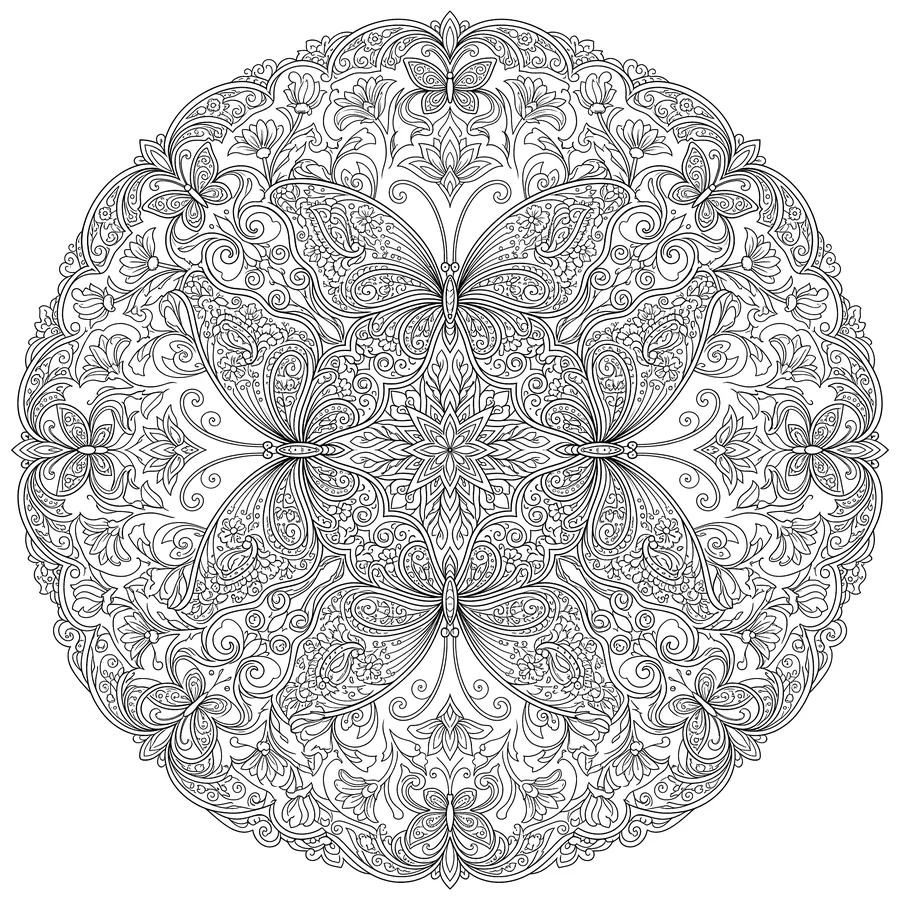
Butterflies undergo one of nature's most remarkable transformations — complete metamorphosis. Inside the chrysalis the caterpillar's body is almost entirely dissolved into a cellular soup before being rebuilt into an adult butterfly over one to two weeks. Butterfly wings are covered in thousands of tiny scales made of chitin, the same material as their exoskeleton. The iridescent colors of some species, like the Blue Morpho, come not from pigment but from the microscopic structure of the scales reflecting light at specific wavelengths.
Coloring ideas: give each of the four main butterfly wings a different color family to make the symmetry visible — blue upper pair, orange lower pair, for example. The scrollwork and paisley sections between them look beautiful in complementary colors: if the wings are blue, try warm gold or coral for the foliage. The tiny outer butterflies can echo one of the main wing colors to tie the whole circle together.
Approach this mandala one butterfly wing at a time rather than going ring by ring, so each wing gets a complete, consistent color treatment before moving to the next. Colored pencils allow you to blend colors within the larger wing sections for a realistic butterfly look.