ColorNest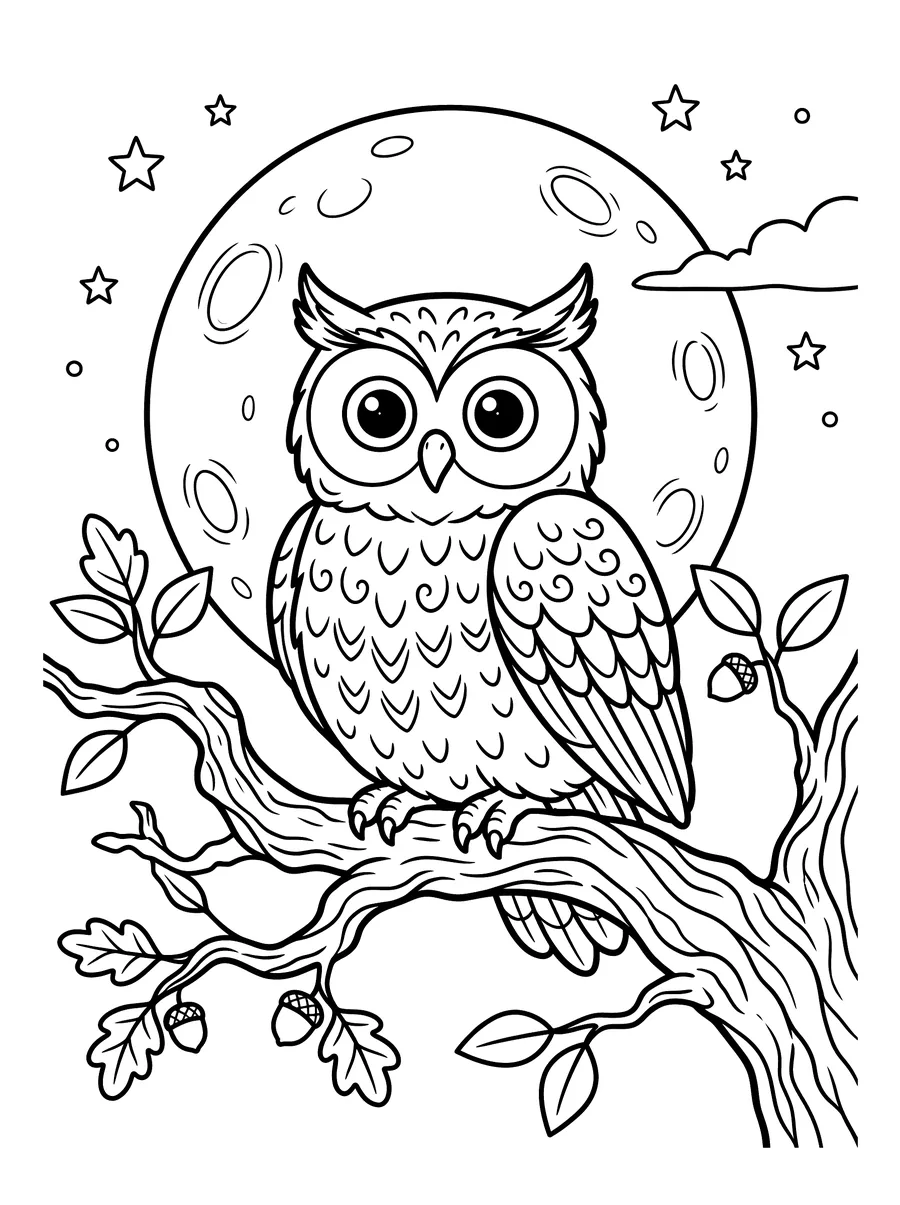
Owls have forward-facing eyes that give them excellent depth perception for hunting, but they cannot move their eyes in their sockets. Instead they can rotate their heads up to 270 degrees in either direction, which lets them look almost all the way around without moving their body. Owls also have asymmetrically placed ears that help them pinpoint the exact location of a sound, even under snow.
Coloring ideas: barn owls have pale golden-brown and white feathers, while great horned owls are rich brown and grey with a white chest. Pick your favorite or invent your own coloring. The large moon behind the owl looks striking in warm gold or pale cream. Color the oak leaves in autumn shades of red, orange, and brown, and make the acorn caps a darker brown than their smooth bottoms.
For younger kids, the round owl body is a satisfying large shape to fill in. Older kids can try creating a feather texture by drawing small V-shaped or crescent marks inside the body area before coloring it, then using two shades of the same color to build up the patterned look.